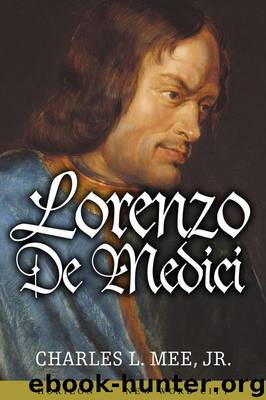
Lorenzo de Medici by Charles L. Mee Jr
Author:Charles L. Mee, Jr. [Charles L. Mee, Jr.]
Language: eng
Format: epub
Tags: Biography/Historical
ISBN: 9781612307190
Publisher: New Word City, LLC
Published: 2014-02-05T16:00:00+00:00
“I have set you at the center of the world,” Lorenzo de Medici’s friend Pico della Mirandola has God saying to humankind, “so that from there you may more easily survey whatever is in the world. We have made you neither heavenly nor earthly, neither mortal nor immortal, so that more freely and more honorably the moulder and maker of yourself, you may fashion yourself in whatever form you shall prefer.”
Such is the basis of humanism, a view of humanity that informs all of Western civilization today, a view of humanity that underlies our political freedoms, our liberal philosophies, and even, in an age in which organized religion has lost some of its hold, a view of humanity that justifies many of our moral beliefs. Humanism developed in the Middle Ages, nurtured by men like Dante and Petrarch, and reached its full flower during the Renaissance, encouraged by such men as Lorenzo de’ Medici.
Humanism is founded upon - indeed it requires - a tremendous confidence in people and their potential. It is a way of thinking that exalts, and exults in, what is known as the universal man, the person who develops all his or her talents, the generalist, the nonconformist, the individualist. The person to be admired is l’uomo singolare, the singular man; and the individual to be admired above all is l’uomo unico, the unique man.
It is, however, a kind of thinking that can go wrong: Fondolo of Cremona once had a chance to push the pope and the emperor of the Holy Roman Empire off a high tower and lived his entire life regretting that he had not done it - not because he disliked them, but because he had missed his golden opportunity to win fame by doing it. Similarly, one of the rulers of Siena made a pastime of recklessly flinging huge boulders from the top of a mountain.
Yet, trust in the individual gives us one of our most prized ideals as well, for belief in individualism implies tolerance for all individuals - the very basis of humanness. That trust, if we can believe Marsilio Ficino, created a golden age in Florence: If “we are to call any age golden, it is beyond doubt that . . . such is true of this our age. . . . For this century, like a golden age, has restored to light the liberal arts, which were almost extinct: grammar, poetry, rhetoric, painting, sculpture, architecture, music, the ancient singing of songs to the Orphic lyre, and all this in Florence.”
The first essential ingredient of this golden age of humanism was a revival, a rebirth, a “Renaissance” of the learning and ideals of antiquity. It depended first, therefore, upon the scholars who scoured the world for ancient manuscripts and rediscovered classical works on philosophy, architecture, politics, and the arts. It depended, secondly, upon multiplying those manuscripts, copying them by hand, and seeing that they were distributed around Italy to men who would read them, argue about them, and adapt the old ideas to new situations.
Download
This site does not store any files on its server. We only index and link to content provided by other sites. Please contact the content providers to delete copyright contents if any and email us, we'll remove relevant links or contents immediately.
| Africa | Americas |
| Arctic & Antarctica | Asia |
| Australia & Oceania | Europe |
| Middle East | Russia |
| United States | World |
| Ancient Civilizations | Military |
| Historical Study & Educational Resources |
Room 212 by Kate Stewart(5119)
The Crown by Robert Lacey(4814)
Endurance: Shackleton's Incredible Voyage by Alfred Lansing(4780)
The Iron Duke by The Iron Duke(4354)
The Rape of Nanking by Iris Chang(4211)
Joan of Arc by Mary Gordon(4109)
Killing England by Bill O'Reilly(4001)
Say Nothing by Patrick Radden Keefe(3983)
I'll Give You the Sun by Jandy Nelson(3445)
Shadow of Night by Deborah Harkness(3367)
Hitler's Monsters by Eric Kurlander(3341)
Mary, Queen of Scots, and the Murder of Lord Darnley by Alison Weir(3210)
Blood and Sand by Alex Von Tunzelmann(3203)
Eleanor & Park by Rainbow Rowell(3169)
Darkest Hour by Anthony McCarten(3129)
Margaret Thatcher: The Autobiography by Thatcher Margaret(3081)
Book of Life by Deborah Harkness(2937)
Red Famine: Stalin's War on Ukraine by Anne Applebaum(2932)
The One Memory of Flora Banks by Emily Barr(2863)
